

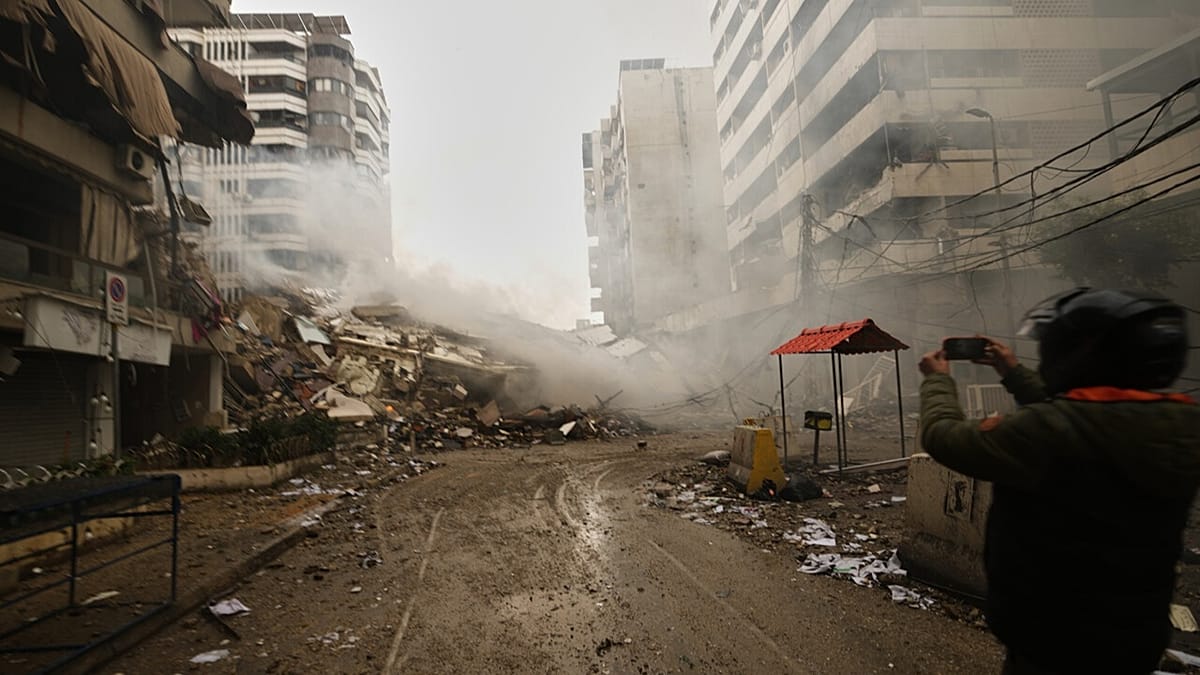
Overnight strikes in southern Lebanon killed at least four people, Lebanese state media and the government said on Sunday, as Israel presses ahead with its campaign it says is targeted against Iran-backed Hezbollah.

ADVERTISEMENT
ADVERTISEMENT
Lebanon’s state-run National News Agency (NNA) said Israel struck “an apartment in a residential building” in a northern district of the coastal city of Sidon, killing one person and causing a fire.
Footage showed damage to the third storey of an apartment building as the Lebanese army cordoned off the area and rescue teams worked to extinguish the blaze.
Nearby residents rushed into the street, some carrying belongings. Residential buildings in Sidon have been hit by multiple Israeli strikes this week, leaving many residents displaced.
To the southeast of Sidon, in the village of Al-Qatrani, three people were killed in an overnight Israeli strike, according to Lebanon’s health ministry.
The Israeli military said in a statement on Sunday it continued to strike infrastructure used by Hezbollah throughout Lebanon, and hit “several Hezbollah launch sites” in Al-Qatrani, where it said the armed group was preparing to fire off missiles.
It also said it destroyed “command centres” belonging to Hezbollah’s Radwan Force in Beirut.
Hezbollah said Sunday it was targeting several Israeli troop positions in villages close to the border.
UN chief urges diplomacy and international support for Lebanon
Israel is fighting a second front in the war in the Middle East in southern Lebanon alongside the air campaign against Iran it launched with the United States more than two weeks ago.
According to Lebanon’s health ministry, Israeli air strikes have killed 826 people in Lebanon, including 106 children, since the start of the latest war, which began on 2 March with Hezbollah firing missiles at Israel after former Iranian Supreme Leader Ayatollah Ali Khamenei was killed in an Israeli airstrike.
Lebanese President Joseph Aoun has proposed negotiations with Israel, but has yet to receive a response.
US news site Axios reported on Saturday that Israel was planning a major ground invasion of Lebanon “aiming to seize the entire area south of the Litani River,” citing US and Israeli officials.
The area, covering hundreds of square kilometres, is already subject to Israeli evacuation warnings.
Israel has already sent some ground forces into Lebanon and late on Saturday Hezbollah said it was engaged in ongoing “direct clashes” with Israeli forces in Khiam.
The health ministry said 31 paramedics had been killed this month, and accused Israel of repeatedly “targeting ambulance crews while they were performing rescue duties.”
The Israeli military accused Hezbollah of using ambulances militarily and its spokesperson Avichay Adraee warned that Israel would act “in accordance with international law against any military activity” by any Hezbollah use of medical facilities or ambulances.
UN chief Antonio Guterres said on Saturday on a visit to Beirut that diplomatic channels remained open to end the war between Israel and Hezbollah and urged the international community to support Lebanon.
Guterres insisted “there is no military solution, only diplomacy” and dialogue.
The UN chief launched a $325 million (€283 million) humanitarian appeal to support Lebanon as it responds to the displacement of hundreds of thousands of people amid sweeping Israeli army evacuation orders.
In just 10 days, more than 800,000 people in Lebanon have been displaced by war, just over a year since the last conflict uprooted over a million Lebanese from their homes.
That’s one in every seven people in the tiny country, according to humanitarian organisation the Norwegian Refugee Council. Many don’t have a place to stay and the cash-strapped government has only been able to accommodate roughly 120,000 people as it scrambles to open shelters and bring in more supplies.
Additional sources • AFP