

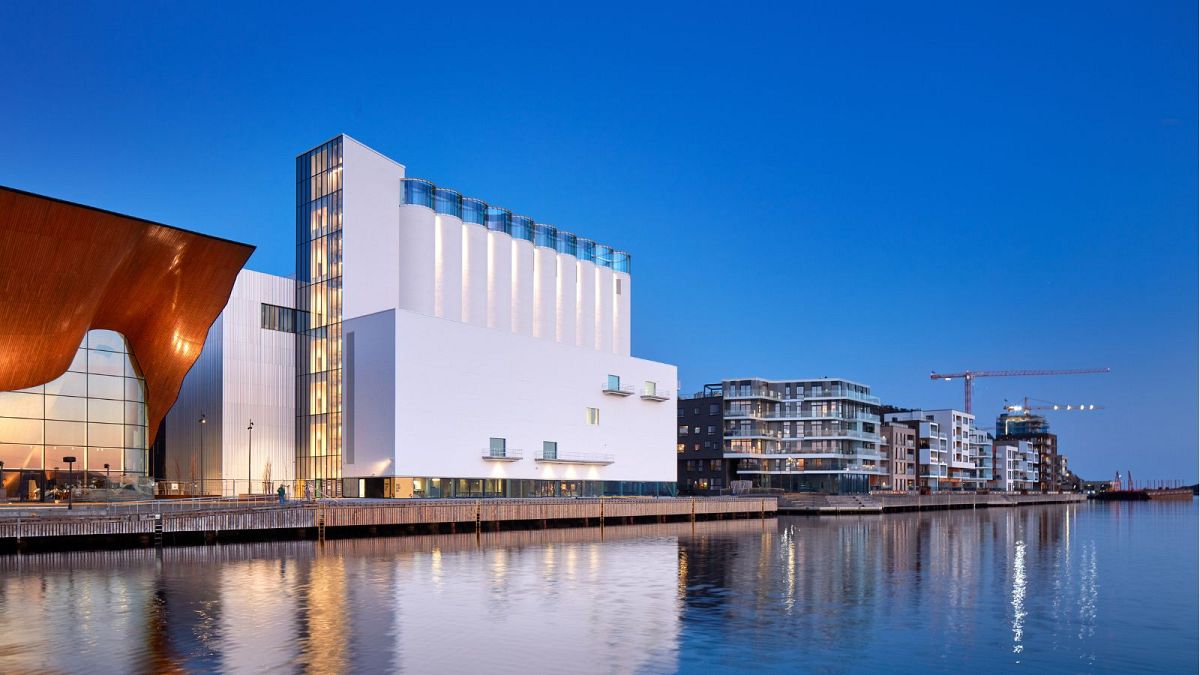
Dwelling to the largest assortment of Nordic artwork, a transformed grain silo is placing Kristiansand on Europe’s cultural map.
 ADVERTISEMENT
Ask any taxi driver, waiter, or pleasant native promoting crocheted monsters in a classic boutique: Kristiansand has the greatest climate in Norway.
Heat and vibrant in Could, its pier is pimpled with folks consuming ice cream and yappy Yorkshire terriers, little kernels of life lolling beneath the towering cylindrical buildings of a grain silo turned gallery.
The story of the Kunstsilo begins 9 years in the past, when hedge fund supervisor Nicolai Tangen – identified in Norway as the “trillion greenback man” – determined to donate his artwork assortment to his hometown.
Made up of modernist items spanning 1930-1990, Tangen’s assortment options roughly 5,500 works that cowl 560 completely different artists from each Nordic nation. Most of them are unknown, their kinds a mix of experimentation and European influences like surrealism.
“It is the artwork that appeals to me and it is the artwork that I grew up with,” says the 57-year-old, who started his assortment in the 90s and in addition accomplished a grasp’s diploma in artwork historical past at the Courtauld Institute of Artwork in London when he was 36.
“I like to purchase issues that are out of favour so that you could construct correct volumes of works and you are not at all times in competitors with quite a lot of different folks,” he says.
Kristiansand has roughly 130,000 inhabitants and was beforehand identified for its zoo and amusement park (Norway’s hottest attraction, apparently.) Lately, locals like Tangen have been cultivating a cultural sector to encourage extra guests and enrich the lives of present residents. The event of the Kunstsilo, from an old industrial constructing right into a slick modern gallery, has been key to this.
“It is an essential pupil city and it will likely be extra attention-grabbing to be a pupil right here. Extra attention-grabbing to work right here, and extra attention-grabbing to dwell right here. Simply higher. Then, I hope [the Kunstsilo] will get a bit extra competitors [going] between the museums in Norway,” says Tangen.
From korn to kunst
Staring up at its ceiling, huge prisms beaming with blue sky, it is inconceivable to not really feel as small as a bit of corn. The Kunstsilo’s areas are without delay intimidating and welcoming: from the brightly lit, oak-lined spiralling staircase, to the woozy glass-bottomed views that flip guests under right into a flurry of dots.
“We constructed upon the structural system of the unique constructing to then create a sort of thought of variation inside,” says Barcelona-based architect Magnus Wåge, who, alongside two different corporations (Mendoza Partida and BAX studio) received the undertaking after coming into a contest in 2016.
“This constructing is a really particular instance of Norwegian industrial structure,” explains Wåge. “It was very attention-grabbing to see how we may type of improve the sculptural and expressive character of the house,” he continues.
In-built the Nineteen Thirties and as soon as residence to fifteen,000 tons of grain, the silo’s stern and imposing functionalist design established it as an iconic landmark of the metropolis.
Then, in 2008, it ceased operations for good: a waterfront husk of historical past.
Preserving and expressing this historical past has been core to its glow-up from grain to gallery.
“The brand new and the old type of play collectively, however are clearly distinguishable,” says Wåge. “We have now allowed the silo to have a really sturdy character so you possibly can see the traces of the new concrete versus the old concrete, additionally permitting it to be a bit un-precise.”
Reaching this level wasn’t all a can of corn, nevertheless. Disputes started throughout growth that led to the then-mayor dropping his job after the metropolis realised it will even be footing the gallery’s €60m invoice (of which Tangen put in roughly €18m).
Any lingering resentments appear to have dissipated with the constructing’s opening on 11 Could. As evening falls and its insides glow beside the tutu-inspired ruffly roof of a neighbouring performing arts constructing, there’s this sense of a as soon as dormant vitality dancing once more.
‘Angst, melancholy, jealousy – all the good things in life’
One in every of the most memorable items inside is an set up on the prime ground, by Norwegian artist Marianne Heske.
ADVERTISEMENTFirst offered at the Biennale de Paris exhibition in 1980, ‘Gjerdeløa’ is an almost 400-year-old hay barn that was transported from a mountainside in Sunnmøre.
“It is [made from] pine tree, which could be very, very sturdy. It is as sturdy as metal, in order that they knew learn how to construct homes in the medieval age,” says Heske, exhibiting guests the intricately carved symbols inside. “You see that dwelling folks have been right here, and the traces of them,” displays Heske.
Thought of considered one of the most essential examples of Norwegian artwork, it is a hanging reminder of how essential artistic areas are, and have at all times been, to communities in expressing themselves and connecting with folks previous and current.
It is part of the inaugural exhibition ‘Passions of the North’, a show of over 600 works from the Tangen assortment.
Not like different curated exhibitions, there is not one fashion or particular narrative thread that ties these works collectively. As an alternative, it seeks to seize a particular kind of temper.
ADVERTISEMENT“Angst, melancholy, jealousy – all the good things in life,” says Tangen, when requested what he feels defines Nordic artwork.
“There is a fairly truthful aspect of loneliness and disappointment in the Nordic area, balanced by gentle and solar and good days.”
Judging by the excitable reception to the Kunstsilo, it appears like the latter are right here to remain in Kristiansand.
‘Passions of the North’is open now at the Kunstsilo in Kristiansand, Norway.